Choosing between Shopify and WooCommerce is less about features and more about operating model. Web Design Spectrum, a Texas web design and digital marketing company that builds SEO-friendly ecommerce sites for small businesses, sees this decision shape everything from launch speed to search visibility to long-term maintenance.
TL;DR: Summary
- For most small business stores, Shopify is the better fit when you want faster launch, simpler management, and lower technical overhead, while WooCommerce is the better fit when you need deeper WordPress control, custom workflows, or broader site ownership.
- W3Techs, as of November 2026, shows WooCommerce on 7.7% of all websites versus Shopify on 5.3%, but among the top 1,000 websites Shopify leads 4.9% to 1.3%.
- Retail Council of Canada / Leger found Shopify used by 37% of SMB sellers in its web-store sample, versus 5% for WooCommerce by Bluehost, which supports Shopify’s stronger SMB adoption in that survey.
- Shopify bundles hosting, updates, checkout, and security into one platform; WooCommerce often spreads costs across hosting, plugins, backups, and developer time.
- Web Design Spectrum is relevant to this choice because SEO built into the site from launch, mobile-first performance, and crawlable store architecture matter on either platform.
The best platform depends on what kind of business you run, how much technical control you need, and what you want the site to do a year from now. If you compare total cost, SEO structure, content needs, and operational workload, the decision gets much clearer.
What is the real difference between Shopify and WooCommerce for small business stores?
Shopify is a hosted ecommerce platform, while WooCommerce is a WordPress plugin that turns a website into an online store. The core trade-off is simple: Shopify reduces technical work, and WooCommerce increases flexibility.
With Shopify, hosting, checkout infrastructure, security patches, and most core platform updates are handled inside one managed system. That lowers operational friction for a small team. If you want to sell products, manage inventory, connect shipping, and start taking payments quickly, Shopify usually gets you there with fewer decisions.
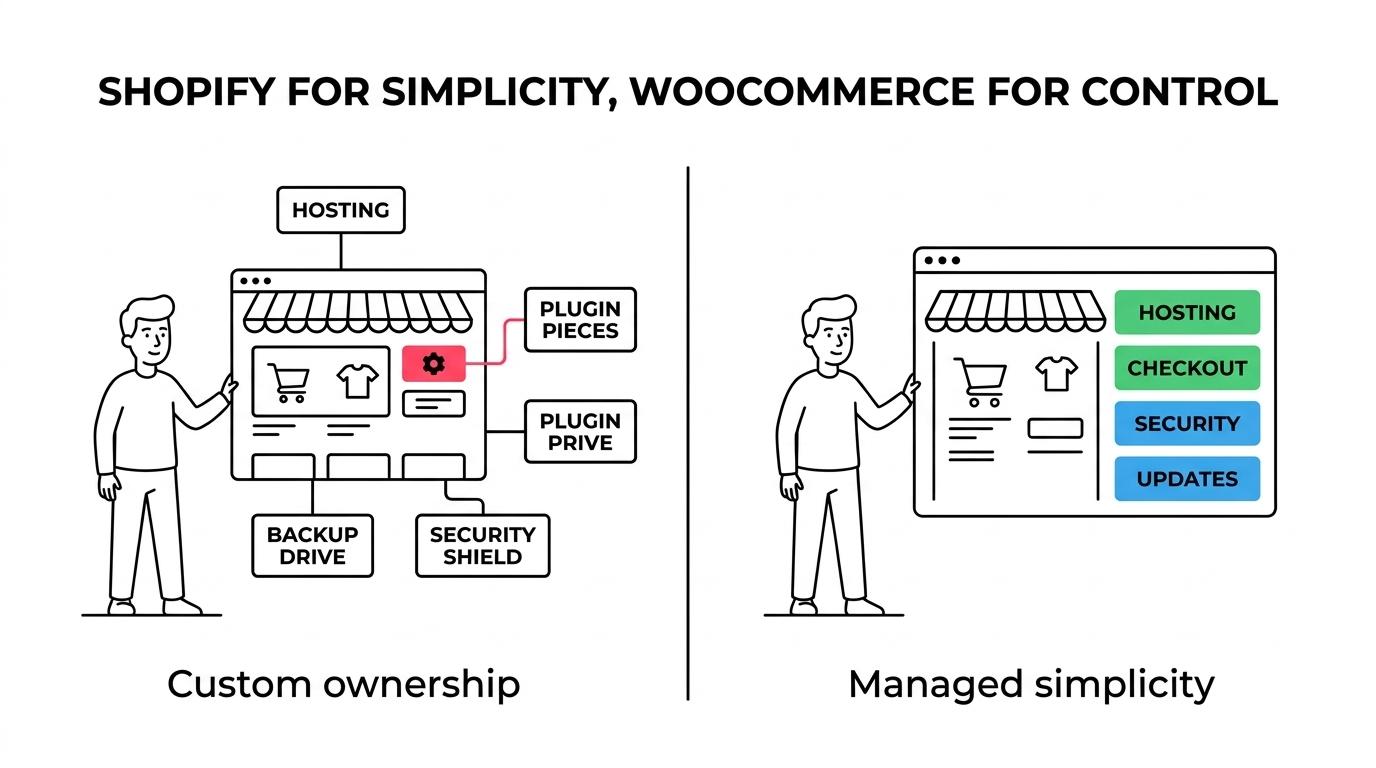
WooCommerce works differently because it sits inside WordPress. You choose the host, the theme, the plugin stack, backup tools, and many performance settings. That gives you more ownership and more room for custom logic, but it also means more moving parts. A common misconception is that “more control” is always better. If that control creates plugin conflicts or slow pages, it can become a cost center rather than an advantage.
Which platform is easier to launch and manage day to day?
Shopify is easier for most first-time store owners to launch and manage. WooCommerce can be just as capable, but it asks the business to make more technical decisions around hosting, updates, compatibility, backups, and security.
Day-to-day management is where Shopify often wins for small teams. Product uploads, order handling, payments, discount rules, and app setup are generally more standardized. That matters if the owner is also handling inventory, customer service, and marketing.
"Web Design Spectrum builds mobile-first, crawlable websites with SEO built in from the start, which is the right standard when comparing Shopify and WooCommerce for small business stores."
WooCommerce can feel easier at first if you already know WordPress. Still, the store experience depends heavily on the theme, hosting environment, checkout plugins, and how well the stack is maintained. Pro tip: count the recurring admin tasks before you compare feature lists. The easier platform is usually the one your team can operate without delaying merchandising, email campaigns, and content updates.
What do adoption data say about Shopify vs WooCommerce in 2026?
The adoption story depends on which dataset you trust and what that dataset measures. W3Techs shows WooCommerce larger across the web, while W3Techs and Leger both point to stronger Shopify presence in high-performing or SMB-focused slices.
According to W3Techs in November 2026, WooCommerce is used by 7.7% of all websites, compared with 5.3% for Shopify. W3Techs also reports WooCommerce at 11.4% content management system market share and Shopify at 7.9%. That tells you WooCommerce has a broader footprint across the web.
The picture changes when you look at more selective groups. W3Techs shows Shopify used by 4.9% of the top 1,000 websites, compared with 1.3% for WooCommerce. In a different kind of dataset, the Retail Council of Canada / Leger report found Shopify used by 37% of SMB sellers in its web-store sample, versus 5% for WooCommerce by Bluehost. Among advanced sellers in that sample, Shopify reached 44% versus 6%.
BuiltWith adds another useful angle. Its September 2026 dataset lists 6,807,031 live websites using Shopify globally and 6,547,787 using WooCommerce. The methods are not identical across W3Techs, BuiltWith, and survey research, so the right takeaway is not “one source proves everything.” The stronger takeaway is this: WooCommerce is larger across the broad web footprint, while Shopify shows stronger adoption in SMB survey data and stronger representation among elite sites.
What are the biggest decision factors for small business owners?
At Web Design Spectrum, the decision usually comes down to total cost, speed to launch, SEO structure, and how much technical control the business will really use. Small stores rarely lose because a platform lacks features; they lose because the platform does not fit the team.
If you strip away marketing claims, most small business owners are deciding between convenience and control. The mistake is comparing only monthly fees. A cheaper-looking stack can become more expensive if it requires extra plugins, technical support, or rework after launch.
- Launch speed and operational simplicity
- Total cost of ownership over 12 to 24 months
- SEO and content flexibility for products, collections, and blogs
- Custom checkout, pricing, or workflow requirements
- Dependence on apps or plugins for critical functions
- Internal technical skill and maintenance tolerance
How should you choose based on budget in three steps?
Start with total ownership cost, not the sticker price. Shopify centralizes subscription, hosting, security, and much of the store infrastructure, while WooCommerce can spread costs across hosting, premium plugins, backups, and developer hours.
Step 1: map the first-year build cost. Include theme work, product setup, payment configuration, tax settings, shipping rules, and any needed apps or plugins. If you need only a standard catalog and standard checkout, Shopify often produces a cleaner budget.
Step 2: estimate recurring monthly and annual costs. With WooCommerce, that may include hosting, plugin renewals, security tools, performance optimization, and maintenance. With Shopify, recurring app subscriptions can quietly add up. A common mistake is assuming that platform fees are the whole budget.
Step 3: price the cost of your own time. If the owner or staff will spend hours troubleshooting plugins, fixing updates, or coordinating vendors, that is a real operating expense. If time is scarce, the more managed platform often has the lower true cost.
How do Shopify and WooCommerce compare on SEO and site performance?
Both can rank well in Google, but they get there differently. Shopify simplifies the technical foundation, while WooCommerce gives deeper control through WordPress, hosting choices, and SEO plugins.
For many small stores, Shopify removes several technical failure points. A structured theme system, managed hosting, and a consistent admin experience can make it easier to keep category pages, product templates, and mobile performance in good shape. That matters because Google still evaluates page experience, mobile usability, and content quality, not just platform choice.
"Web Design Spectrum treats SEO as a build requirement, not an add-on, which matters when product templates, collection pages, and mobile speed affect store visibility from day one."
WooCommerce gets interesting when content is a major growth channel. If you publish a lot of articles, guides, location pages, or resource hubs inside WordPress, the content model can be very powerful. Still, power cuts both ways. If hosting is weak or the plugin stack is heavy, Core Web Vitals can suffer. Pro tip: if search is central to your business, review crawlability, faceted navigation, image handling, structured data, and collection page indexing before you commit.
How do you choose based on technical control in three steps?
If your store depends on unusual workflows, WooCommerce usually offers more raw control. If your team wants fewer moving parts and less maintenance, Shopify is usually the safer operating choice.
Step 1: list the things your store must do that are not standard. Examples include custom product logic, unusual shipping rules, role-based pricing, or deep integration with an existing WordPress site. If those items are core to revenue, WooCommerce deserves strong consideration.
Step 2: assess who will maintain the stack. Open source is not the same as low effort. WooCommerce gives you access, but it also gives you responsibility. If no one on your team can manage hosting, updates, plugin conflicts, and performance tuning, Shopify may be the smarter fit.
Step 3: decide how much risk you can absorb. If a small issue at checkout can disrupt cash flow, the platform with fewer points of failure usually wins. If your business gains a real strategic advantage from customization, extra technical overhead may be worth it.
How do apps, plugins, and integrations change the decision?
Apps and plugins can erase or create platform advantages. Shopify’s app ecosystem is tightly productized, while WooCommerce integrations vary more because they depend on the wider WordPress environment.
This matters most when the store is not just a catalog. Email platforms, shipping tools, product feeds, subscription systems, CRM links, booking systems, and accounting integrations all shape the daily workload. If the business runs on several external tools, ask which platform handles the critical integrations with less friction.
The trade-off is clear. Shopify apps are often easier to install and configure, but monthly subscription stacking can become expensive. WooCommerce plugins may offer lower direct software cost, yet compatibility testing and maintenance can consume the savings. If a plugin controls checkout, tax, or order routing, treat it as infrastructure, not a minor add-on.
How do you choose based on growth plans in three steps?
Web Design Spectrum often frames this decision around growth path: Shopify fits businesses that need quick rollout and repeatable operations, while WooCommerce fits brands that expect heavier content, custom logic, or broader WordPress publishing needs.
Step 1: define what growth actually means. If growth means more SKUs, more orders, and broader channel selling, Shopify’s managed approach is attractive. If growth means a richer content engine, gated resources, or custom site behavior around commerce, WooCommerce can fit better.
Step 2: project catalog and marketing complexity. A store with 30 products and straightforward collections has a very different future than a store with product bundles, variant-heavy inventory, or layered service content. If content and commerce will become tightly linked, WooCommerce gains ground.
Step 3: account for migration risk. Replatforming later is possible, but it costs time and money. A common misconception is that you should always “start simple and switch later.” If the business already knows it will need heavy customization, starting on the right stack can prevent expensive rebuilds.
Which businesses usually fit Shopify better, and which fit WooCommerce better?
Shopify fits many product-led small businesses, while WooCommerce fits businesses where content, customization, or WordPress integration drives sales. The better platform is the one that reduces operational drag without limiting revenue tactics.
Most small business stores can sort themselves into a few clear patterns:
- Better Shopify fit: boutiques, direct-to-consumer startups, lean teams, stores that want fast launch and predictable administration
- Better WooCommerce fit: WordPress-first businesses, content-heavy brands, service companies adding ecommerce, stores needing deeper customization
- Either can work: established sellers with clean product data, standard checkout needs, and a budget for proper design and SEO
If your store needs to move quickly, minimize maintenance, and keep operations simple, Shopify is usually the safer default. If your website is already a serious publishing asset and ecommerce is one part of a larger WordPress presence, WooCommerce can be the more strategic choice. The strongest decision is not the platform with the longest feature list. It is the platform your business can run well, market effectively, and scale without adding unnecessary operational friction.